Common Spa Hotel Etiquette Mistakes: The Definitive Guide to Wellness Conduct
The modern spa hotel is a unique ecosystem, a liminal space where the rigid structures of high-end hospitality intersect with the profound vulnerability of personal wellness. Unlike a standard luxury hotel, where the primary objective is seamless service and logistical efficiency, the spa environment demands a specific type of social contract. It is an environment built on the preservation of a collective atmosphere—a sensory “commons” where the behavior of one individual directly dictates the physiological state of another. As the wellness industry has moved from clinical hydrotherapy toward a more lifestyle-oriented, “social spa” model, the friction between individual preference and communal tranquility has intensified.
Navigating this terrain requires an understanding that goes beyond simple politeness. It involves a sophisticated grasp of “liminal conduct”—the behavior appropriate for a space that is neither entirely public nor strictly private. Guests are often required to oscillate between shared thermal circuits and the extreme intimacy of a treatment room, all while clad in minimal attire. This transition creates a psychological fragility that many hospitality structures struggle to manage without a well-informed guest. When this social contract fails, the result is not merely an awkward encounter; it is a direct disruption of the therapeutic intent for which guests have often paid a significant premium.
The nuance of spa conduct is further complicated by geographical and cultural variances. A “Banya” in Eastern Europe, an “Onsen” in Japan, and a luxury resort spa in Arizona operate under vastly different unspoken rules regarding nudity, silence, and hygiene. However, as global travel standardizes the “luxury spa” experience, a set of universal norms has emerged—and with them, a frequent set of transgressions. This editorial exploration seeks to deconstruct these dynamics, providing a rigorous framework for understanding the ethical and practical dimensions of the spa environment, ensuring that the pursuit of relaxation remains a shared success rather than a private conflict.
Understanding “common spa hotel etiquette mistakes”
To define common spa hotel etiquette mistakes, one must first acknowledge the shift from “service” to “atmosphere.” In a restaurant, a mistake might be a misplaced order; in a spa, a mistake is a loud conversation in a relaxation room that spikes the cortisol levels of twelve other guests. Many people frequently conflate “freedom of the guest” with “freedom from the rules” within this domain. Although these environments often appearidenticalc to leisure spaces like pools or lounges, their operational functions differ significantly. Facility operators typically establish the spa as a sensory sanctuary, and when guests fail to recognize this, they inadvertently compromise the product the hotel is selling: silence.
The risk of oversimplification arises when guests assume that all spas implement standardized pricing or conduct architecture. In fact, a day spa in a suburban shopping center operates on a volume-based model where a certain level of chatter might be tolerated. Conversely, a luxury hotel spa employs a prestige-based model that unbundles the “experience” into various separate premium tiers, each requiring a higher degree of decorum. Understanding this distinction becomes a vital factor for guests in structuring their behavior, while simultaneously ensuring that the service provider can maintain the intended environment without the guest feeling over-regulated.
Ultimately, the most significant mistakes are those rooted in a lack of “Spatial Intelligence.” This involves failing to read the room—literally. It is the refusal to adapt one’s volume, pace, and digital footprint to the specific sub-zone of the spa. Whether it is a misunderstanding of the “nude-optional” policy in a German sauna or the misuse of the hydrotherapy circuit, these errors stem from an inability to transition from the ego-centric world of business and travel into the communal-centric world of wellness.
Historical Evolution: From Communal Baths to Private Sanctuaries
The historical trajectory of spa conduct is a move from the highly social toward the intensely private. In Roman times, the thermae were the civic centers of the empire. Etiquette was based on social hierarchy and public discourse; silence was not a requirement. This was a communal bath culture where the “mistake” would have been isolation, not noise. The Middle Ages saw a decline in this communalism due to health fears, eventually giving way to the 18th and 19th-century European “Cure” culture. In towns like Bath or Vichy, etiquette became rigid and medicalized, dictated by physicians and “Master of Ceremonies.”
In the mid-20th century, the American “health farm” introduced a more disciplined, almost militaristic approach to wellness. Etiquette was about compliance with a regimen. Today, we exist in the “Social Media Era” of spas, which has introduced a brand-new category of etiquette failure: the digital intrusion. The historical “Sanctuary” is now under threat by the “Content Creator.” This evolution has shifted the burden of etiquette from the institution to the individual. Where once a physician or a Roman guard might have enforced norms, the modern guest is now the primary governor of the spa’s tranquility.
Conceptual Frameworks: The Sensory Commons
To navigate the complexities of spa behavior, we can utilize several analytical frameworks that clarify why certain actions are considered transgressions.
The Sensory Commons Model
This framework views the spa environment as a “shared resource,” similar to clean air or public parks. Silence, cleanliness, and privacy are the resources. When a guest “over-consumes” silence by talking, they are effectively polluting the commons. This mental model helps guests understand that their behavior is not a private choice but an environmental impact.
The Liminal Vulnerability Theory
Spas are “liminal”—they exist between the states of clothed/public and naked/private. In this state, humans are biologically more prone to the “startle response.” This explains why a sudden loud noise in a spa feels significantly more aggressive than a loud noise in a lobby. Recognizing this vulnerability allows guests to adjust their movements and volume to accommodate the heightened sensitivity of those around them.
The Circulation Logic
Thermal circuits (sauna, steam, cold plunge) follow a specific physiological logic. Breaking this logic—such as jumping into a cold plunge without showering off sauna sweat—is a hygiene mistake that also disrupts the “flow” of the facility. Understanding the spa as a machine for circulation helps guests move through it with more intention and less friction.
Key Categories of Etiquette Transgressions and Trade-offs
Identifying common spa hotel etiquette mistakes requires categorizing them by the type of disruption they cause.
| Category | Typical Transgression | The Operational Impact | The Strategic Pivot |
| Acoustic | Loud chatting; Phone calls | Breaks the “Alpha Wave” state of other guests. | Use a “Library Whisper” or absolute silence. |
| Digital | Photography; Video calls | Violates the privacy and vulnerability of others. | Use lockers for all devices; zero-tolerance for cameras. |
| Hygiene | Skipping the “Pre-Plunge” shower | Contaminates shared water; increases chemical load. | Shower between every thermal station. |
| Temporal | Arriving late for treatments | Forces the therapist to rush or shorten the service. | Arrive 30 minutes early to down-regulate. |
| Spatial | “Towel Reserving” of loungers | Prevents other guests from utilizing relaxation zones. | Only occupy a chair while physically present. |
| Olfactory | Excessive perfume or tobacco | Overwhelms the subtle aromatherapy of the spa. | Arrive “scent-neutral.” |
Realistic Decision Logic
When a guest is unsure of the rules, the decision should follow the “Lowest Common Denominator” logic. If you are unsure if talking is allowed, stay silent. If you are unsure if a towel is required in the sauna, bring one. This conservative approach to etiquette ensures that you never become the source of another guest’s disruption.
Detailed Real-World Scenarios
The Digital Intruder
A guest at a luxury resort wants to document the beautiful mountain views from the infinity pool. They take several selfies, inadvertently capturing other guests in the background who are in robes or swimwear.
-
The Mistake: Prioritizing personal content over communal privacy.
-
Operational Impact: Other guests complain to management; the “vibe” shifts from relaxation to performance.
-
Failure Mode: The guest argues that “it’s a public space,” failing to recognize the specific “liminal” privacy of a spa.
The “Dry” Sauna Violation
In a high-end European-style sauna, a guest brings a plastic water bottle and sits directly on the wood without a towel.
-
The Mistake: Hygiene and safety. Sweat on the wood causes rot and odor; plastic can off-gas toxins in high heat.
-
Constraint: The guest may be unaware of the “Towel-to-Skin” rule.
-
Second-Order Effect: The spa must sand or deep-clean the wood, increasing maintenance costs.
The Treatment Room Talker
During a deep-tissue massage, the guest spends the entire 60 minutes talking to the therapist about their work stress.
-
The Mistake: Disrupting the therapist’s focus and their own nervous system’s ability to relax.
-
Decision Point: Is the therapist engaging back? (Often, therapists talk to be polite, while wishing for silence.
-
Result: The guest leaves feeling “relaxed” but without the profound physiological benefits of a quiet session.
Resource Dynamics: The Hidden Costs of Poor Conduct
The financial and operational planning of a spa hotel must account for the “Etiquette Margin.” Poor conduct has direct and indirect costs that eventually impact the guest’s wallet.
| Resource | Impact of Etiquette Failure | Cost Type |
| Labor | Staff must intervene in guest conflicts or perform extra cleaning. | Direct (Payroll) |
| Chemicals | Poor hygiene requires higher chlorine/bromine levels in pools. | Direct (Supplies) |
| Brand Equity | Negative reviews citing “loud guests” or “lack of privacy.” | Indirect (Revenue) |
| Opportunity Cost | A guest who leaves early due to noise won’t book a second treatment. | Indirect (Sales) |
Effective management of common spa hotel etiquette mistakes allows a hotel to keep its operating costs lower, which theoretically keeps treatment prices more stable. When guests act as “co-managers” of the environment, the entire system becomes more efficient.
Strategies and Systems for the Informed Guest
-
The “Acoustic Audit”: Upon entering a new zone, pause for ten seconds to gauge the ambient noise level. Match or drop below it.
-
The “Device-Free” Protocol: Commitment to leaving the smartphone in the room or locker. Digital detox is a core component of modern spa value.
-
The Thermal “Shower Sandwich”: Shower before entering a pool, shower after a sauna, and shower before a treatment.
-
The Early-Arrival Buffer: Arriving 30-45 minutes before a treatment is not just about logistics; it is about “Mental Decompression.”
-
Therapist Communication: Use the “Three-Sentence Rule” for treatment instructions (Pressure, Temperature, Focus Areas), then remain silent unless necessary.
-
Nudity Literacy: Researching the “Sauna Culture” of the specific country. (e.g., in Germany, swimwear in a sauna is often seen as unhygienic).
-
The “Lounge Etiquette” Scan: If you leave a lounger for more than 15 minutes, take your belongings with you.
Risk Landscape: The Compounding Effect of Social Friction
The risk in spa etiquette is not usually a single event, but a “Cascade of Discomfort.” When one guest talks loudly, others feel permitted to do the same. This “Broken Windows Theory” of wellness can quickly turn a luxury sanctuary into a standard public pool.
Compounding Risks include:
-
Staff Burnout: Therapists who constantly have to “shush” guests or manage conflicts lose their therapeutic focus.
-
Safety Hazards: Misusing thermal equipment (like pouring water on electric sauna heaters that aren’t designed for it) can lead to equipment failure or injury.
-
Legal/Privacy Issues: Photography in locker rooms can lead to severe legal ramifications and immediate expulsion from the property.
Governance and Long-Term Adaptation
For the frequent traveler, spa etiquette should be treated as a “Practice” rather than a set of rules. It requires ongoing self-monitoring and adaptation to different environments.
-
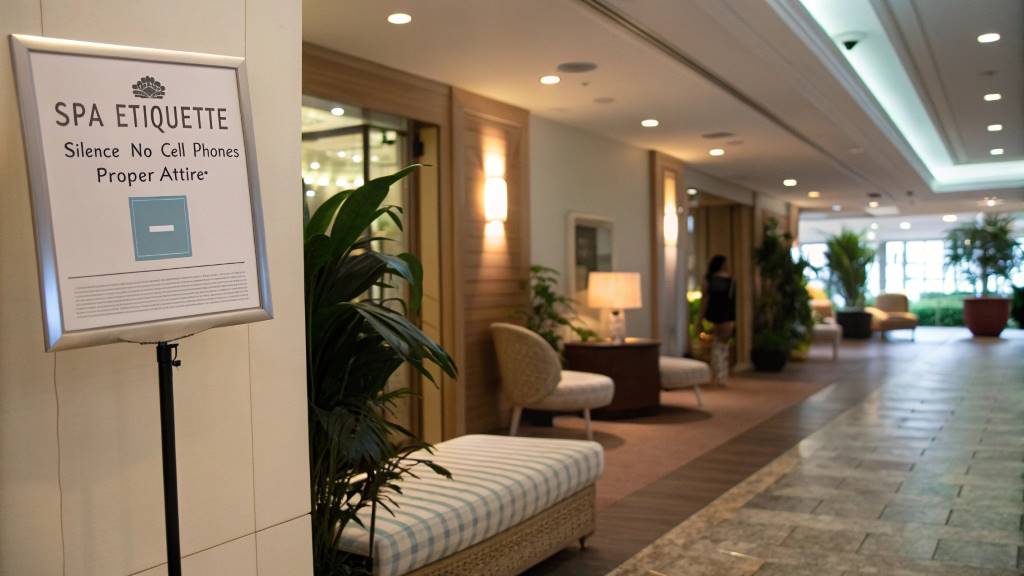
Review the “House Rules”: Every spa has a menu or a plaque. Reading it for two minutes can prevent 90% of mistakes.
-
Adjustment Triggers: If you notice people staring or if a staff member makes eye contact after you speak, take it as a “Soft Signal” to adjust your behavior.
-
The Layered Checklist:
-
Phone silenced and stored?
-
Showered before the pool?
-
Robe and slippers correctly sized?
-
Voice at a “Library Level”?
-
All personal items off shared loungers?
-
Measurement and Evaluation of the Wellness Environment
How does a guest (or a manager) know if the etiquette is succeeding?
-
Qualitative Signal: The “Density of Silence.” A high-quality spa has a palpable, heavy silence that feels restorative, not awkward.
-
Quantitative Signal: The “Intervention Frequency.” How often do staff have to remind guests of the rules?
-
Documentation Example: Many high-end spas now use “Silent Service” indicators—cards or digital check-ins where guests explicitly request zero-chatter treatments.
Common Misconceptions and Oversimplifications
-
Myth: “I paid for the room, I can do what I want.” Correction: You paid for access to an environment; you did not purchase the right to disrupt it.
-
Myth: “Staff will tell me if I’m doing something wrong.” Correction: In luxury hospitality, staff are trained to avoid confrontation. They may never tell you, but they (and other guests) will notice.
-
Myth: “Talking quietly is fine.” Correction: In a silent relaxation room, even a whisper carries and can prevent others from reaching a meditative state.
-
Myth: “I need my phone for the timer/music.” Correction: The spa provides clocks and ambient sound specifically so you don’t need your device.
-
Myth: “Sauna suits are better for sweating.” Correction: Most spas ban these as they are unhygienic and can cause overheating in a controlled spa environment.
Ethical and Contextual Considerations
The ethics of spa behavior involve a “Respect for Labor.” A massage therapist is performing a physically demanding, intimate task. Etiquette mistakes that involve personal boundaries or “Power Tripping” (treating the therapist as a servant rather than a practitioner) are the most severe. Furthermore, there is a “Cultural Humility” component. When traveling, the guest is an ambassador. Disregarding local bathing customs is not just an etiquette error; it is a form of cultural insensitivity that reflects poorly on the traveler’s home country.
Conclusion: Synthesis of the Shared Sanctuary
Mastering the nuances of the spa environment is a move toward “Social Wellness.” It is the recognition that our own health is inextricably linked to the atmosphere we co-create with those around us. By avoiding common spa hotel etiquette mistakes, the guest transitions from a passive consumer of luxury to an active guardian of tranquility. This requires patience, a degree of self-erasure, and a commitment to the “Sensory Commons.”
In the end, the most sophisticated spa guest is the one who is barely noticed. They move with quiet intention, respect the physiological boundaries of the facility, and leave no digital or acoustic footprint. This level of conduct ensures that the spa remains what it was always intended to be: a place where the world falls away, and the only thing remaining is the restorative power of silence and care.